

A dermatologist is the right specialist to see when you want a skin tag checked or removed. Most skin tags are harmless and need no treatment. However, an examination matters when a growth is new, changing, painful, bleeding without an obvious reason, or does not look typical.
A board-certified dermatologist can confirm the diagnosis and choose a suitable removal method. Avoid treating the growth yourself. A wart, mole or skin cancer can be mistaken for a tag, while home treatment can cause bleeding, infection, burns or delayed diagnosis.
Use This Quick Decision Guide First
| What you notice | Sensible next step |
|---|---|
| A soft, stable tag that causes no discomfort | Removal is usually unnecessary. Monitor it and mention it at a routine visit if you are unsure what it is. |
| A tag repeatedly catches on clothing, jewelry or a razor | Arrange a routine dermatologist appointment to discuss removal. |
| A growth on an eyelid affects your sight or becomes irritated | Book an in-person medical assessment; treatment near the eye requires extra precision. |
| The growth gets larger, changes color or texture, becomes firm, develops a sore, or bleeds without being snagged | Have it examined promptly instead of treating it as a cosmetic skin tag. |
| Many tags appear over a short period | See a dermatologist and ask whether a primary-care assessment is appropriate. |
| Bleeding will not stop with firm pressure, or a DIY attempt causes worsening pain, pus, spreading redness or fever | Seek urgent medical care. |
What a Typical Skin Tag Looks and Feels Like
A skin tag, medically called an acrochordon, is a benign growth made from skin tissue. It is often small, soft and smooth. Many are skin-colored, although they may be darker. A tag commonly hangs from the skin on a thin stalk. Common sites include the neck, underarms, groin, inner thighs and eyelids—places where friction occurs.
Skin tags are usually painless. They can become tender, itchy or bleed when rubbed or caught by a razor. They are not contagious.
Appearance alone is not a safe diagnosis. The NHS comparison of skin tags, warts and moles notes that warts tend to be firmer and rougher, while moles are commonly flat or oval. Real lesions do not always follow textbook patterns, however.
When a Dermatologist Should Examine the Growth
Book an appointment if you do not know whether the spot is a skin tag. Evaluation is particularly important when it:
- grows quickly or keeps changing;
- has several colors or an irregular shape;
- feels firm rather than soft;
- crusts, oozes or bleeds without friction;
- becomes persistently painful, itchy or fails to heal;
- develops in a sensitive location, including an eyelid, genital area or around the anus; or
- appears alongside many new growths in a short time.
These signs do not automatically mean cancer. They mean the label “skin tag” should not be assumed. The National Cancer Institute advises medical assessment when a mole changes in color, size, shape, texture or height, or begins to itch, bleed or ooze. A dermatologist can distinguish many harmless growths by examination and decide whether a biopsy or laboratory analysis is warranted.
Why Choose a Dermatologist for Skin Tag Removal?
The main benefit is not simply getting rid of a bump. It is receiving the correct diagnosis before anything is destroyed.
A dermatologist can confirm whether the growth fits a skin tag, select a technique based on its stalk, size and location, account for bleeding and healing risks, and send tissue for pathology when the diagnosis is uncertain.
This expertise is especially useful on the face, eyelids and body folds, and for people who develop dark marks or raised scars after injuries. The AAD says dermatologists can usually remove skin tags during an office visit, often without follow-up.
What Happens at the Appointment
The visit should begin with diagnosis, not an automatic procedure. The dermatologist will ask when the growth appeared, whether it has changed, and whether it hurts, itches or bleeds. They may also ask about skin cancer, diabetes, pregnancy, immune conditions and keloid scars.
Bring a list of medicines and supplements. Some affect bleeding, but never stop a prescribed medicine without guidance from the clinician who prescribed it.
The dermatologist then examines the spot, sometimes with a magnifying device called a dermatoscope. A classic tag often needs no testing. If it looks unusual, a biopsy or microscopic examination after removal may be recommended. Same-day removal depends on the diagnosis, clinic schedule and insurance rules.
Before agreeing, ask what method will be used, whether numbing medicine is needed, what mark may remain, what aftercare involves and whether tissue will be sent to a laboratory.
How Dermatologists Remove Skin Tags
There is no single best method for every tag. According to the AAD’s skin-tag guidance, dermatologists commonly use snip removal, electrodesiccation or cryosurgery.
| Method | What the dermatologist does | What to expect afterward | Important trade-off |
|---|---|---|---|
| Snip removal | Numbs the area when needed, removes the tag with sterile surgical scissors or a blade, and controls bleeding | A tiny superficial wound may be covered with a bandage | Gives an immediate result, but minor bleeding, a small scar or pigment change is possible |
| Electrodesiccation | Uses a fine electrical instrument to heat and destroy the tag | A small scab forms; the AAD says treated skin generally heals in one to three weeks | Useful for controlled treatment, but heat can leave a mark or color change |
| Cryosurgery | Applies an extremely cold substance, usually liquid nitrogen, to freeze the tissue | The area may blister or scab before the tag falls away | The result is not immediate, and temporary or lasting pigment change can occur |
Large or broad-based growths may need a different excision. Location also changes the decision: a method used on the neck may not suit an eyelid. Cryotherapy deserves careful discussion in brown or black skin because pigment change may be more noticeable.
Laser treatment is not automatically safer or scar-free. Ask why the recommended technique suits your lesion.
Does Removal Hurt, and How Long Does It Take?
Most removals are brief outpatient procedures. A numbing injection may sting for a few seconds. Snipping should then feel like pressure. Cryotherapy can cause short burning or stinging, while electrodesiccation is performed with appropriate pain control.
The number and size of tags affect appointment time. Most people resume normal activities immediately, but the area needs protection from rubbing, shaving and picking while it heals.
No ethical clinician can promise a completely invisible result. Possible effects include tenderness, bleeding, infection, a small scar and temporary or permanent lightening or darkening of the treated skin. The NHS specifically notes that post-treatment hyperpigmentation can be more relevant in black or brown skin.
Skin Tag Removal Cost and Insurance
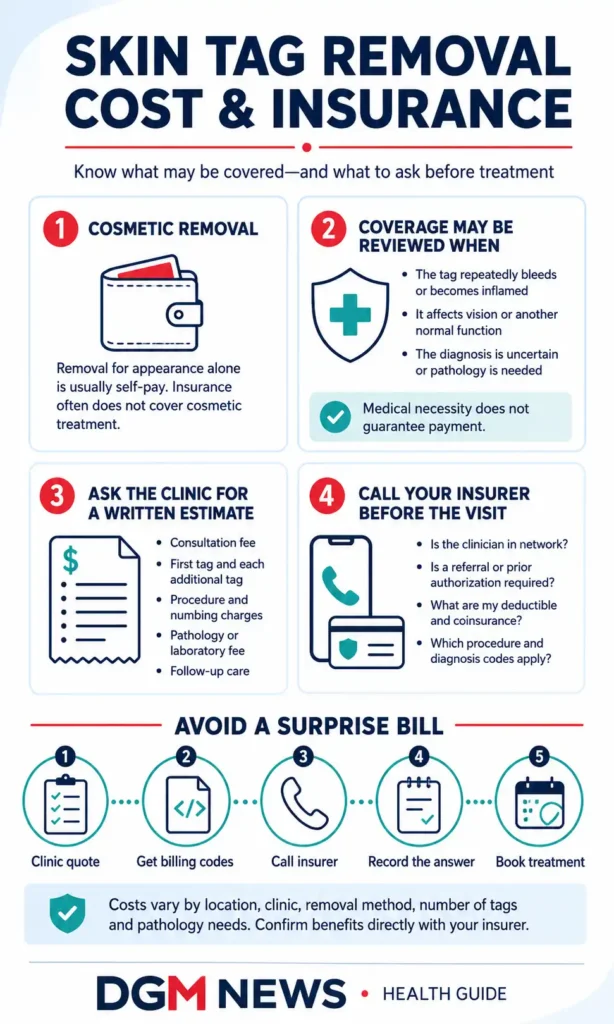
Removal for appearance alone is generally treated as a cosmetic service, so health insurance often does not cover it. Coverage may differ when a lesion bleeds, causes repeated inflammation, affects vision, needs diagnostic testing or meets another plan-specific definition of medical necessity. A clinician’s recommendation does not guarantee payment.
Ask the clinic for a written estimate covering:
- the consultation or new-patient fee;
- the charge for the first tag and each additional tag;
- pathology charges if tissue needs testing; and
- any follow-up care.
Ask your insurer whether a referral or prior authorization is required. Request procedure and diagnosis codes from the clinic if needed. This prevents confusing a procedure quote with the total bill.
Why At-Home Skin Tag Removal Is a Poor Shortcut
Do not cut a suspected tag with scissors or nail clippers, tie it with thread or dental floss, burn it, or apply wart acid or an unverified removal serum. Home freezing products are not equivalent to controlled treatment by a trained clinician, particularly on the face, eyelids, genitals or areas with poor visibility.
The AAD’s warning about DIY mole and skin-tag removal states that no at-home products marketed to remove moles, skin tags and other growths have FDA approval. Reported risks include skin injury, infection, scarring and delayed skin-cancer diagnosis. Wart remover can damage the softer skin of a tag, while cutting or tying may leave injured tissue behind and cause difficult bleeding.
If you have already attempted removal, stop applying additional products. Follow a healthcare professional’s advice. Seek prompt care for persistent bleeding, increasing pain, warmth, swelling, pus, red streaks or fever.
Can Multiple Skin Tags Point to Another Health Issue?
Having a skin tag does not mean you have diabetes or another disease. Tags are common, and age, genetics, pregnancy, skin folds and friction can all contribute. However, research has found associations between multiple skin tags and obesity, insulin resistance, type 2 diabetes and metabolic syndrome.
The important word is “association.” A tag cannot diagnose these conditions. If numerous tags appear suddenly or keep recurring, a dermatologist may suggest discussing blood sugar and other risk factors with your primary-care clinician. The current NCBI clinical review of acrochordons supports considering the wider metabolic picture in people with multiple or recurrent lesions.
Removal does not correct an underlying health issue. The treated tag usually does not return in the same place, but new ones can form elsewhere. Reducing rubbing may improve comfort but cannot prevent every tag.
How to Choose the Right Dermatologist
Use this checklist when comparing clinics:
- Confirm that the clinician is a board-certified dermatologist or appropriately licensed professional in a dermatology practice.
- Ask whether every growth is examined before treatment.
- Look for experience treating the relevant area, especially the eyelid or genital skin.
- If you have a deeper skin tone or keloid history, ask how the clinician reduces pigment and scar risks.
- Request a clear explanation of the recommended method and alternatives.
- Confirm fees, insurance handling and pathology costs in advance.
- Make sure the clinic provides written aftercare instructions and a way to report complications.
- Be cautious of “zero scar,” “guaranteed painless” or “instant permanent cure” claims.
Aftercare: A Simple Healing Timeline
After treatment, the dermatologist may apply ointment and a bandage. Follow your specific instructions, keep the site clean and change the covering as directed.
Mild tenderness, redness or a small scab can be normal. Do not pick it or shave across the area. A cryosurgery blister should be protected as directed rather than punctured.
The wound or scab should gradually settle. Healing varies with the technique, tag size, location and personal health. Once the skin closes, protect it from excessive sun exposure.
Contact the clinic if pain, swelling or redness is getting worse rather than better, if drainage looks like pus, if the wound opens, or if bleeding continues despite firm pressure. Fever or spreading redness requires prompt medical advice.
The Bottom Line
A board-certified dermatologist is the best choice when a suspected skin tag needs diagnosis or removal. A stable, painless tag can usually be left alone. An irritated tag can often be removed during a short office visit. A changing, bleeding, firm or unusual growth should be examined promptly before anyone attempts to destroy it.
Professional care provides something a home kit cannot: diagnostic judgment, sterile technique, controlled bleeding and a treatment plan matched to your skin. If you are uncertain about a growth, book an examination first and decide about removal only after you know what it is.
Medical disclaimer: This article provides general education and cannot diagnose a skin growth or replace advice from a qualified healthcare professional. Seek urgent care for uncontrolled bleeding, a serious reaction or signs of spreading infection.