

If your teeth look yellow, start by booking an examination with a licensed general dentist. The dentist must first determine whether the colour comes from surface stains, tartar, naturally yellow dentin, thinning enamel, tooth decay, medication, an old injury, or existing dental work.
For healthy natural teeth, professional cleaning, dentist-supervised whitening, or a combination of both may improve the colour. However, whitening will not change the shade of fillings, crowns, veneers, dentures, or implants. Deep internal discoloration may require bonding, veneers, internal bleaching, or treatment of an unhealthy tooth.
Do not assume that every yellow tooth needs bleaching. The correct treatment depends on why the tooth changed colour.
Which Dentist Should You Visit for Yellow Teeth?
A general dentist is the right first contact for most people. They can examine your teeth and gums, identify the likely cause, perform or arrange professional cleaning, offer whitening, and refer you when specialist care is necessary.
See a general dentist first
Choose a general dentist when:
- Several teeth have gradually become yellow.
- You regularly drink coffee, tea, cola, or red wine.
- You smoke or use chewing tobacco.
- Plaque or tartar is visible near the gums.
- You want to know whether professional whitening is suitable.
- You have fillings, crowns, veneers, or sensitive teeth.
- You have not had a dental examination recently.
A dental hygienist may carry out cleaning where local regulations allow, but the dentist should diagnose cavities, gum problems, trauma, or internal discoloration before cosmetic treatment begins.
Consider a prosthodontist for complex cosmetic treatment
A prosthodontist has advanced training in restoring the appearance and function of teeth. Consider one when multiple teeth need veneers or crowns, your bite needs to be considered, previous cosmetic work has failed, or your visible teeth contain several mismatched restorations.
The American College of Prosthodontists describes prosthodontists as dentists with additional training in areas such as crowns, veneers, implants, esthetics, and complex restoration.
An endodontist may be needed for one dark tooth
A single tooth that becomes darker after an injury may have a damaged or non-vital pulp—the tissue containing the tooth’s nerves and blood vessels. A general dentist can test the tooth and refer you to an endodontist if root canal treatment or internal bleaching is appropriate.
Do not try to whiten one suddenly darkened tooth at home. It needs diagnosis first.
Is the Yellow Colour a Stain or Something Inside the Tooth?
Healthy teeth are not naturally paper-white. Dentin, the layer beneath enamel, has a yellow tone. Because enamel is partly translucent, some yellow may show through even when a person has excellent oral hygiene.
The colour pattern provides useful clues, although it cannot replace a dental examination.
| What you notice | Possible explanation | Sensible next step |
|---|---|---|
| Most teeth are evenly light yellow | Natural dentin, genetics, or age-related enamel changes | Dental examination followed by whitening discussion |
| Yellow or brown film near the gums | Plaque, tartar, tobacco, or surface staining | Professional cleaning and gum assessment |
| Stains after coffee, tea, wine, or tobacco | Extrinsic surface staining | Cleaning, habit changes, and possible whitening |
| One tooth is darker than nearby teeth | Previous trauma, decay, pulp damage, or an old restoration | Prompt dental examination |
| White, brown, or black spots | Enamel changes or possible tooth decay | Examination before any bleaching |
| Yellow teeth with bleeding or swollen gums | Plaque accumulation or gum disease | Treat gum health before cosmetic whitening |
| Uneven colour around crowns or fillings | Natural teeth have changed shade, but restorations have not | Coordinated whitening and restoration plan |
The American Dental Association classifies discoloration as extrinsic, intrinsic, or a mixture of both. Extrinsic stains sit mainly on the enamel surface. Intrinsic discoloration develops within enamel or dentin and may be related to age, tooth development, medication, disease, or injury.
What Happens at the First Dental Appointment?
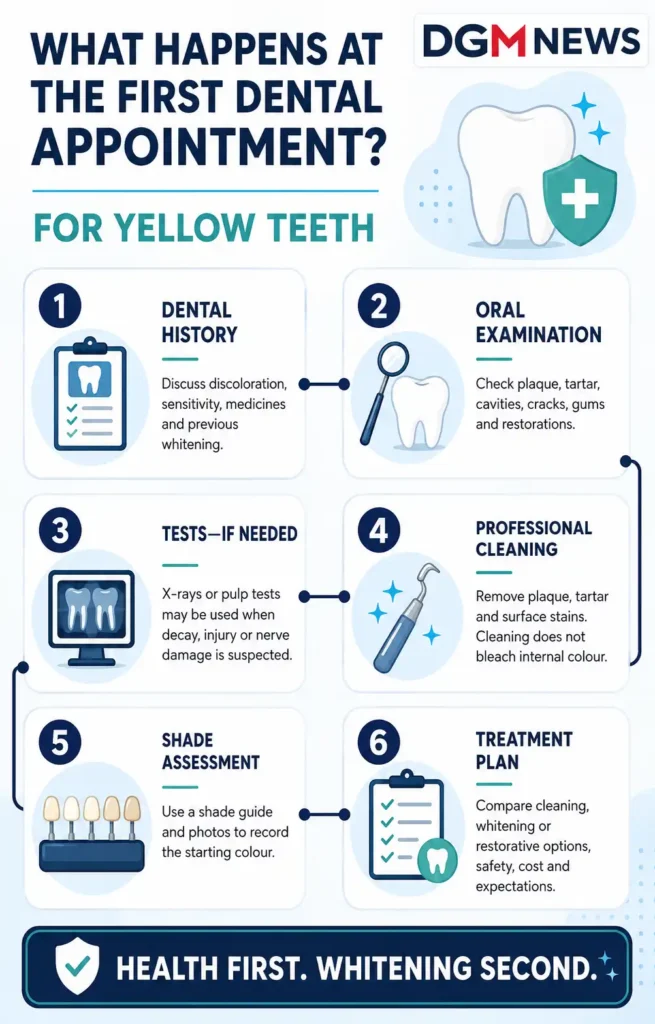
A responsible dentist will not begin by promising a certain number of shades. The appointment should establish whether whitening is safe and likely to work.
1. Dental and medical history
Tell the dentist about previous dental injuries, sensitivity, gum problems, whitening attempts, medications, smoking, pregnancy or breastfeeding, and recent changes in tooth colour.
Mention when the yellowing started and whether it affects every tooth or only one area.
2. Teeth and gum examination
The dentist will look for:
- Plaque and hardened tartar
- Cavities, cracks, or leaking fillings
- Enamel wear or erosion
- Gum inflammation or recession
- Exposed tooth roots
- Crowns, veneers, implants, and fillings
- Differences between the colour of individual teeth
X-rays or pulp tests may be recommended when decay, an old injury, infection, or nerve damage is suspected. They are not automatically required for every whitening consultation.
3. Cleaning and shade assessment
Professional cleaning can remove plaque, tartar, and some external stains. It cannot bleach the natural colour inside a tooth.
After cleaning, the dentist can compare your tooth colour with a shade guide and decide whether additional whitening is worthwhile. Photographs may help document the starting shade and monitor change.
4. A treatment plan based on the cause
The plan should explain which treatment is recommended, what it cannot correct, the likely number of visits, possible sensitivity, maintenance, and total cost. Be cautious if a clinic recommends veneers or crowns without first discussing less invasive options.
Dentist Treatments for Yellow Teeth Compared
| Treatment | Best suited to | Typical process | Important limitation |
|---|---|---|---|
| Professional cleaning | Plaque, tartar, and external stains | Scaling and polishing during a dental visit | Does not change the tooth’s natural internal colour |
| In-office whitening | Healthy natural teeth requiring faster improvement | Gum protection followed by professionally applied whitening gel | May cause temporary sensitivity; results vary |
| Dentist-provided custom trays | Gradual whitening with professional supervision | Custom trays and prescribed gel used at home for days or weeks | Requires consistent and correct use |
| Approved over-the-counter products | Mild discoloration after a dental assessment | Lower-strength strips or gels used as directed | Less controlled and may produce uneven results |
| Dental bonding | Localised or deep discoloration that does not bleach well | Tooth-coloured resin covers the visible surface | Can stain or chip and may need future repair |
| Porcelain veneers | Persistent widespread discoloration or combined shape concerns | Thin ceramic shells are bonded to front teeth | Usually irreversible and more invasive than whitening |
| Dental crowns | A discoloured tooth that is also weak, cracked, or heavily restored | The tooth is prepared and covered with a crown | Removes more tooth structure; not a first choice for healthy teeth |
| Internal bleaching | A root-canal-treated tooth that has darkened internally | Whitening material is placed inside the tooth by a dentist | Only appropriate after diagnosis and suitable root canal treatment |
Professional whitening normally uses hydrogen peroxide or carbamide peroxide to break down colour compounds. Yellow-toned natural teeth often respond better than gray discoloration, but no dentist can guarantee an exact final shade.
According to the ADA’s patient guidance, bleaching only affects natural teeth. Crowns, veneers, and tooth-coloured fillings remain the same colour, which can create an uneven result.
A Practical Treatment Decision Path
Use this sequence when discussing yellow teeth with a dentist:
- Check for disease first. Cavities, gum inflammation, cracked teeth, or infection should be treated before whitening.
- Remove plaque, tartar, and surface stains. If cleaning produces enough improvement, bleaching may not be necessary.
- Assess the colour of healthy natural teeth. In-office whitening offers a faster change, while custom trays provide a slower, more controlled option.
- Identify visible restorations. The dentist may need to coordinate whitening with the replacement of old, mismatched fillings or crowns.
- Reassess deep discoloration. If healthy teeth do not respond adequately, discuss bonding or veneers. Start with the most conservative suitable treatment.
- Investigate a single dark tooth separately. That tooth may need pulp testing, root canal treatment, internal bleaching, bonding, or a crown depending on its health.
This staged approach prevents a cosmetic treatment from hiding—or worsening—an untreated dental problem.
When Whitening May Need to Wait
A dentist may postpone whitening if you have active decay, cracked teeth, exposed roots, uncontrolled gum disease, severe sensitivity, or poor-fitting restorations. Whitening gel can reach vulnerable areas and cause significant discomfort.
Children, teenagers, pregnant people, and those who are breastfeeding need individual professional advice. Recommendations and legal age limits differ between countries.
Temporary tooth sensitivity and gum irritation are the most commonly reported side effects. The ADA advises following product directions because excessive whitening can damage teeth and gums. Contact the dentist if sensitivity becomes intense, persists, or interferes with eating and drinking.
Yellow-Teeth Remedies to Avoid
Trying to make teeth white too quickly can create a bigger dental problem. Avoid:
- Applying lemon juice, vinegar, or other acids to teeth
- Scrubbing enamel with activated charcoal
- Using household bleach or undiluted peroxide
- Combining several whitening products
- Leaving whitening gel on longer than instructed
- Brushing aggressively with abrasive powders
- Buying unlabelled products from social media sellers
- Receiving whitening or veneers from an unlicensed provider
Citric acid can contribute to enamel erosion, while abrasive products may remove surface material without changing the colour inside the tooth. As enamel becomes thinner, the yellow dentin underneath may become more visible.
The Cleveland Clinic specifically advises caution with activated charcoal and citric acid in home whitening products.
Checklist for Choosing a Dentist for Yellow Teeth
Before agreeing to treatment, check whether the clinic:
- Uses a properly licensed dentist
- Examines your teeth and gums before whitening
- Explains the likely cause of the discoloration
- Checks for cavities, cracks, gum disease, and sensitivity
- Records existing crowns, veneers, fillings, or implants
- Discusses cleaning and whitening before irreversible treatment
- Explains possible sensitivity and gum irritation
- Provides realistic expectations instead of guaranteeing a brilliant-white shade
- Gives a written estimate covering appointments and maintenance
- Has a plan for managing uneven colour or existing restorations
Ask the dentist these six questions:
- What is causing my teeth to look yellow?
- Do I need cleaning or dental treatment before whitening?
- Which option preserves the most natural tooth structure?
- Will my fillings, crowns, or veneers look different afterward?
- How will you reduce or manage sensitivity?
- What maintenance or replacement work might I need later?
How to Help the Results Last
Whitening is not permanent. Daily habits and the original cause of discoloration affect how quickly stains return.
Brush twice daily with fluoride toothpaste and clean between your teeth once a day. Reduce tobacco use and frequent exposure to strongly coloured drinks. Rinse with water after coffee, tea, cola, or red wine rather than repeatedly bleaching your teeth.
After acidic drinks or foods, wait before brushing so you do not scrub softened enamel. Keep dental cleaning and examination appointments at the interval recommended for your oral health. Use whitening touch-ups only according to your dentist’s instructions.
When Yellow or Dark Teeth Need Prompt Attention
Arrange a dental examination promptly if:
- One tooth changes colour suddenly
- A tooth becomes gray after an injury
- You notice brown or black spots
- Yellowing appears with pain or strong sensitivity
- Your gums bleed, swell, or pull away from the teeth
- A tooth becomes loose
- You develop a bad taste, fever, or swelling
Seek emergency medical help if swelling around the mouth, neck, or eye makes it difficult to breathe, swallow, or speak. These symptoms may indicate a spreading dental infection and are not cosmetic concerns.
The Bottom Line
The best dentist for yellow teeth is usually a licensed general dentist who examines the cause before recommending treatment. Surface staining may improve with professional cleaning. Healthy natural teeth may respond to supervised whitening. Deep discoloration, damaged teeth, and mismatched restorations need a more individual plan.
Choose diagnosis before bleaching and conservative care before veneers or crowns. The safest result is not simply the whitest shade—it is a brighter smile achieved without overlooking the health of your teeth and gums.