

A business may record hundreds of sales, purchases, salary payments and tax entries every month. Someone must convert those transactions into accurate books, timely returns and useful reports. A Certified Industrial Accountant course is designed to develop these practical, day-to-day accounting skills.
In India, the term generally refers to a job-oriented certificate programme offered by ICA Edu Skills. It focuses on business accounting, TallyPrime, taxation, spreadsheets and communication. It can help a beginner prepare for an entry-level accounts role, but applicants should understand its scope before enrolling.
Certified Industrial Accountant Course at a Glance
| Question | Practical answer |
|---|---|
| What type of programme is it? | A skill-based accounting certificate course |
| What does it teach? | Bookkeeping, financial statements, TallyPrime, GST, direct tax, payroll, inventory and office applications |
| Who can apply? | The provider lists 10+2 students and graduates as eligible |
| Is prior accounting knowledge required? | The classroom course page says beginners can join after Class 12 |
| How is it delivered? | Classroom and online versions are available |
| What jobs can it support? | Junior accountant, accounts executive, GST or TDS assistant, payroll assistant and related entry-level roles |
| Is it equivalent to CA or CMA? | No. It is a practical training certificate, not a statutory professional qualification |
The provider currently lists different versions of the programme. Course duration, modules, delivery mode and placement terms vary by version, so students should verify the exact batch details in writing before paying.
What Does a Certified Industrial Accountant Do?
“Industrial” does not mean that the learner can work only in a factory. The skills apply wherever a business needs organised accounts, including trading companies, service firms, manufacturers, retailers and small enterprises.
Depending on the employer and experience, a trained candidate may:
- Record sales, purchases, receipts and payments.
- Maintain ledgers and reconcile bank statements.
- Track inventory and assist with stock valuation.
- Process basic payroll, PF and ESI information.
- Prepare GST and TDS working papers and support return filing.
- Help prepare profit and loss accounts and balance sheets.
- Produce management information reports using Excel or accounting software.
The role is operational. A new certificate holder normally supports the finance team rather than making high-level financial decisions or signing statutory audit reports.
How the Course Connects Accounting to Business Operations
The programme’s value lies in turning accounting concepts into repeatable business processes. ICA’s published syllabus includes business computer applications, business accounting, TallyPrime, communication, direct tax, GST and advanced accounts.
Its online curriculum also mentions financial-statement preparation, bank reconciliation, inventory, payroll and return-filing simulations. ICA’s current course information provides the detailed module list.
| Learning area | How a business uses it |
|---|---|
| Business accounting | Records transactions and converts journals and ledgers into final accounts |
| Excel and office applications | Organises data, performs reconciliations and creates MIS reports |
| TallyPrime | Manages vouchers, invoices, inventory, payroll, GST, TDS and reports |
| GST | Supports registration data, invoice checks, return preparation and compliance records |
| Direct tax and TDS | Helps calculate taxable items, prepare working papers and maintain filing data |
| Advanced accounts | Improves closing entries, reconciliations and financial-statement accuracy |
| Business communication | Helps an accountant write emails, explain discrepancies and coordinate with teams |
In a small distribution business, the accountant may record purchase invoices, check tax details, track stock, post receipts and reconcile the bank. At month-end, those records support GST work, payment reports and final accounts. Employers value this ability to connect one transaction with several business outputs.
Course Versions, Duration and Eligibility
ICA’s classroom page currently describes Foundation, Express, standard CIA and CIA Plus versions. It lists the standard classroom programme at 12 months, including internship, while the online standard course is listed at six months.
The online CIA Plus programme is listed at 18 months and adds subjects such as SAP FICO and Zoho Books. These details may change between centres and batches. Therefore, applicants should check the online CIA course and CIA Plus course before admission.
For the online course, the provider lists 10+2 completion and a common entry test among its eligibility conditions. Graduates may also apply. A commerce background is useful but is not presented as compulsory for the beginner programme.
Choose according to the job you want, not the number of modules. A beginner may first need bookkeeping, Excel and Tally, while an experienced learner may gain more from ERP software or deeper taxation practice.
Certified Industrial Accountant vs Other Accounting Qualifications
The abbreviation “CIA” creates confusion. Certified Industrial Accountant and Certified Internal Auditor are not the same credential.
| Qualification | Main purpose | Professional status | Best suited to |
|---|---|---|---|
| Certified Industrial Accountant | Practical accounting, tax and software training | Training certificate; exact issuer depends on the programme | Entry-level accounts work and practical upskilling |
| B.Com | Broad university education in commerce | Academic degree | Students seeking graduation and a wider academic base |
| Chartered Accountant | Accounting, audit, tax, finance and professional practice | Statutory profession regulated by ICAI | Candidates seeking the CA qualification and its recognised professional scope |
| Cost and Management Accountant | Costing, management accounting and strategic finance | Statutory profession regulated by ICMAI | Candidates interested in cost control and management accounting |
| Certified Internal Auditor | Internal audit, governance, risk and controls | Global certification issued by The Institute of Internal Auditors | Audit and risk professionals |
The Institute of Chartered Accountants of India and the Institute of Cost Accountants of India are statutory bodies established under Acts of Parliament. By contrast, the Certified Industrial Accountant programme is a vocational certificate.
The IIA’s Certified Internal Auditor is a separate, globally recognised internal-audit certification.
Therefore, completing this course does not make a person a Chartered Accountant, CMA or IIA-certified internal auditor. It also does not independently provide statutory signing or audit rights. Its purpose is to develop employable accounting skills.
Who Should Consider This Course?
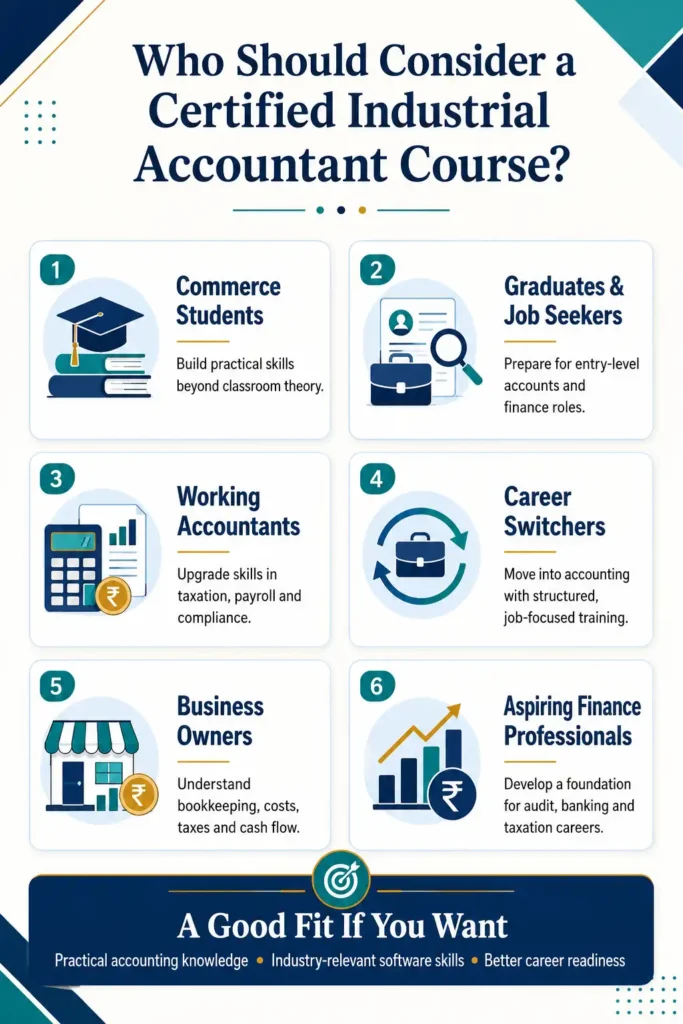
The programme may suit:
- A Class 12 pass-out who wants to explore accounting work.
- A B.Com student or graduate who understands theory but lacks software practice.
- An accounts employee who needs GST, TDS, payroll or TallyPrime skills.
- A small-business owner who wants better control over financial records.
- Someone returning to work who needs structured practice and interview preparation.
It may not be the right primary choice for a student whose goal is statutory practice, an advanced audit designation or a postgraduate academic qualification. Those goals require a different education path.
It is also unsuitable for anyone expecting a certificate alone to guarantee a high salary without practice, accuracy and communication skills.
Career Scope After the Course
A fresher should target roles that match the training level. Relevant openings may include:
- Junior accountant
- Accounts assistant
- Accounts executive
- Accounts payable or receivable executive
- Billing executive
- Payroll assistant
- Inventory accounts assistant
- GST or taxation assistant
- MIS assistant
Actual duties differ by company. In a small business, one employee may handle invoices, bank entries, payroll and basic tax records. A large company may assign only vendor payments, customer collections or reconciliations. Manufacturing businesses may place greater emphasis on inventory, bills of material and cost centres.
Career progress depends on more than the certificate. Employers also assess education, Excel ability, current tax knowledge, accuracy, communication and experience. Demonstrating a complete month-end process is more useful than simply naming software features.
What Salary Can a Certified Industrial Accountant Expect?
There is no single reliable salary for this certificate. Pay depends on the role, city, employer, prior qualification, experience and the amount of work a candidate can handle independently. Treat any fixed “guaranteed salary” claim cautiously.
Ask the institute for recent, centre-specific placement data. Request the number of students who enrolled, completed the programme and secured jobs. The data should also identify job titles, salary ranges and whether internships were counted as placements.
Median salary is more useful for evaluating normal outcomes than the highest package promoted in an advertisement.
How to Evaluate a Course Before Paying
Use the following checks instead of relying only on promotional claims:
- Identify the exact programme: Confirm whether the offer is Foundation, Express, standard CIA, CIA Plus, online or classroom.
- Get the complete syllabus: Check the software versions, GST and income-tax coverage, live assignments and latest curriculum update.
- Request a complete fee sheet: Check tuition, GST, examination, certification, retest and instalment charges.
- Inspect the practical work: Ask whether students create books for a sample business, perform bank reconciliations, prepare payroll and complete GST or TDS simulations.
- Clarify the certificate: Ask who issues each certificate and request a sample. If an outside organisation is named, verify that claim directly with the organisation.
- Read the placement conditions: “Placement support,” “job assurance” and “job guarantee” can have different meanings. Check attendance, marks, location, interview limits and qualifying-role conditions.
- Check the internship: Confirm its duration, assigned work, stipend and eligibility conditions.
- Speak to recent students: Prefer alumni from the same centre, course version and learning mode.
- Review institute policies: Read refund, cancellation, batch-transfer and missed-class rules before making a payment.
Build Proof of Skill, Not Just a Certificate
Before applying for jobs, create a fictional-business portfolio with vouchers, inventory records, a bank reconciliation, payroll entries, GST workings, a trial balance, financial statements and a one-page MIS dashboard.
Remove all real personal or business data. During an interview, explain how one invoice moves through purchase entry, inventory, tax, payment and reporting. This demonstrates process knowledge and makes the training easier for an employer to evaluate.
Frequently Asked Questions
No. CA is a statutory professional qualification regulated by ICAI. Certified Industrial Accountant is a practical certificate course and does not provide the same professional status or rights.
The provider states that prior accounting knowledge is not required for its beginner classroom course and lists 10+2 as an entry level. However, applicants should verify the entry test and batch-specific rules.
It can be useful when the graduate needs hands-on experience with TallyPrime, Excel, GST, TDS, payroll and reconciliations. A graduate who already has these skills should compare advanced or specialised alternatives.
The provider advertises job-guarantee or job-assurance terms for certain versions. That is a provider claim, not an automatic employment outcome. Read the written eligibility and placement conditions before enrolling.
Online learning offers flexibility, while classroom training may provide closer supervision. The better option is the one that includes live practice, regular assessments, instructor feedback and doubt-clearing support.
Yes. It may help an owner understand records, cash flow, inventory, payroll and compliance workflows. However, appropriately qualified professionals should still handle complex tax, audit and legal matters.
Final Assessment
A Certified Industrial Accountant course can bridge the gap between accounting theory and everyday business work. Its strongest value is practical training in bookkeeping, accounting software, taxation support, reconciliation and reporting.
It is most suitable for beginners, commerce graduates seeking job-ready skills and small-business users who want a clearer view of their accounts.
Judge the programme by the quality of its assignments, faculty, current syllabus, internship and transparent placement record—not by the title alone. Verify the exact credential and terms, practise a complete accounting cycle and treat the certificate as the beginning of skill development rather than the end of it.