

Updated July 2026
The average septic tank installation cost is about $8,000 for a complete residential system, but a realistic U.S. budget can range from $3,500 to $12,500 for many conventional installations. A difficult property or an engineered system may cost $15,000 to $50,000 or more. If you only need the tank, the tank itself often costs $500 to $2,500 before installation.
Those numbers look far apart because “septic tank installation” can describe very different jobs. A low estimate may cover only the tank and basic labor. A complete quote may include soil testing, design, permits, excavation, the tank, distribution components, a drainfield, inspections, old-system abandonment, and yard restoration.
Current national cost guides from Angi, NerdWallet, and HomeGuide place a standard project near the ranges above. However, your approved system design—not a national average—determines the final price.
Septic Installation Cost at a Glance
| Project scope | Typical planning range | What the price may include |
|---|---|---|
| Tank only | $500–$2,500 | Tank purchase without excavation, pipes, drainfield, or permits |
| Tank replacement with installation | $3,000–$8,500 | New tank, excavation, placement, and basic connections; drainfield may be excluded |
| Complete conventional system | $3,500–$12,500 | Tank, distribution, conventional drainfield, installation, and some approval costs |
| Alternative system | $5,000–$20,000 | Chamber, pressure distribution, drip, sand filter, or similar design |
| Engineered system on a difficult site | $15,000–$50,000+ | Site-specific design, pumps or treatment equipment, and a specialized drainfield |
| Soil testing, permits, and inspections | Often $1,000–$2,300 combined | Local application, site evaluation, design review, and inspections; fees vary widely |
These are budgeting ranges, not fixed prices. Local rules may require a larger tank or more advanced system than the homeowner expects. Ask whether every estimate covers the same approved design before comparing totals.
First, Know Whether You Are Pricing a Tank or a Complete System
A septic tank is only one part of an onsite wastewater system. It receives household wastewater and separates floating material, liquid effluent, and settled solids. The liquid then travels to a drainfield, where the soil provides further treatment.
The U.S. Environmental Protection Agency describes a typical system as a tank plus a drainfield. Alternative systems may add pumps, treatment media, disinfection, or other components.
This distinction matters when you request quotes:
- Tank-only price: The cost of the concrete, plastic, or fiberglass container.
- Installed-tank price: The tank, delivery, excavation, placement, and connections. It may not include a new drainfield.
- Complete-system price: The tank, pipes, distribution box or dosing equipment, drainfield, labor, approvals, and final inspection.
- Replacement price: The new work plus pumping, crushing, filling, removing, or legally abandoning the old system.
A $4,000 tank replacement and a $14,000 complete system may both be reasonable if their scopes differ. Never compare the final totals of two bids until you compare what each bid includes.
Septic Tank Installation Cost by System Type
Soil, groundwater, slope, lot size, home size, and local rules determine which system the property can use. A homeowner usually cannot choose the least expensive type simply because it fits the budget.
| System type | Broad installed-cost range | Where it may be used | Main cost issue |
|---|---|---|---|
| Conventional gravity or anaerobic | $3,500–$12,500 | Suitable soil, adequate area, and favorable elevation | Drainfield size and excavation |
| Chamber system | $5,000–$12,000 | Sites where approved plastic chambers replace gravel trenches | Chamber layout and site preparation |
| Pressure distribution or drip | $8,000–$18,000 | Shallow soil, uneven terrain, or a need for controlled dosing | Pump tank, controls, tubing, and electrical work |
| Sand filter | $7,000–$25,000+ | Sites needing added treatment before soil dispersal | Filter structure, pump, and engineering |
| Aerobic treatment unit | $10,000–$40,000+ | Limited space or rules requiring higher treatment performance | Treatment unit, controls, service contract, and power |
| Mound system | $10,000–$50,000+ | High groundwater, shallow bedrock, or limited usable native soil | Imported sand, pumps, design, and large construction area |
These broad ranges synthesize current installed-cost data from Angi and HomeGuide. They are not interchangeable quotes because the two databases group engineering, field construction, and equipment differently.
The wide aerobic and mound ranges reflect different sizes, treatment standards, regions, and quote inclusions. For example, one guide may price the treatment unit and standard dispersal area. Another may include engineering, controls, alarms, electrical work, and a complex mound.
The approved plan is the best basis for a reliable estimate.
Conventional Gravity Systems
A conventional system is usually the lowest-cost option when the site has suitable soil, enough undisturbed land, proper setbacks, and adequate fall from the house to the tank and drainfield. Gravity moves effluent through the system, so fewer mechanical parts are needed.
However, “conventional” does not automatically mean cheap. A large field, long sewer line, deep excavation, rock removal, tree clearing, or restricted equipment access can raise the installed cost.
Pumped and Alternative Systems
A pump may be required when wastewater must move uphill or when timed dosing will distribute it more evenly. Alternative designs can make a constrained property usable, but they add equipment, electrical work, alarms, and maintenance.
Ask who will start the equipment, explain the controls, provide the service agreement, and respond to an alarm.
Engineered Systems
An engineered design may be necessary when the site has slow-draining soil, shallow bedrock, a high seasonal water table, steep grades, limited space, or sensitive nearby water.
These systems are expensive because the owner pays for both specialized construction and professional design. Some locations also require ongoing sampling, inspections, or a maintenance contract.
What Determines the Final Septic System Cost?
The tank is visible on an estimate, but the site often controls the price. The following factors usually have the greatest effect.
Soil and Seasonal Groundwater
The soil must accept and treat effluent at the rate assumed in the design. A site evaluation may examine:
- Soil texture
- Soil structure
- Usable soil depth
- Restrictive layers
- Bedrock
- Evidence of seasonal groundwater
- Drainage rate
Some jurisdictions use a percolation test. Others rely more heavily on a soil profile evaluation.
Well-drained, adequately deep soil may support a simple gravity field. Heavy clay, very rapid sand, shallow bedrock, or a high water table may require a larger field or an alternative treatment method.
The EPA notes that unsuitable soil, excessive slopes, and high groundwater can contribute to system failure. Therefore, the design should follow site evidence rather than guesswork.
Number of Bedrooms and Design Flow
Many health departments size residential systems by bedroom count because bedrooms represent potential occupancy. Adding a bedroom can increase the required tank capacity, design flow, and drainfield area even if the household currently has only two people.
Do not order a tank from an online bedroom chart before receiving local approval. Minimum capacity rules vary. The permitting authority may also consider:
- Plumbing fixtures
- Garbage disposals
- Large bathtubs
- Accessory dwelling units
- Home businesses
- Nonresidential use
Drainfield Design and Reserve Area
The drainfield often costs more than the tank. Its price depends on:
- Required absorption area
- Trench depth and length
- Aggregate or chamber material
- Distribution method
- Site grading
- Soil conditions
- Required reserve area
Some codes require a protected replacement or reserve area. A tight lot may need more surveying and careful layout to maintain separation from the home, well, property lines, waterways, pools, and other features.
Excavation and Equipment Access
A contractor needs safe access for an excavator, delivery truck, and sometimes a crane. Narrow gates, overhead lines, fences, landscaping, retaining walls, wet ground, and steep slopes can slow the job.
Rock excavation and dewatering may become change-order items if the conditions were not visible during bidding.
Elevation and Pipe Distance
Long pipe runs require more material and trenching. If gravity cannot provide the required slope, the system may need a lift or dosing pump.
That change can add:
- A pump chamber
- Floats
- Electrical controls
- An alarm
- Electrical installation
- Future pump replacement costs
Permits, Design, and Inspection Rules
Septic systems are generally regulated at the state and local level. According to the EPA’s homeowner guidance, the local health or environmental department typically issues the permit and inspects the work.
The department may also maintain the property’s approved plan and as-built record.
Application fees are only part of the approval cost. The project may also need:
- A site evaluator
- A boundary or location survey
- A septic designer
- A professional engineer
- An installer license
- A municipal permit
- An electrical permit
- Construction inspections
- Final approval
Never start excavation before confirming which approvals are required.
Existing-System Abandonment
A replacement quote should state what will happen to the old tank, drainfield, pumps, and sewage.
Local rules may require pumping and removing the tank. Other jurisdictions may allow a contractor to crush or fill it in place after pumping.
The EPA advises homeowners to ask their local authority how an abandoned system must be handled.
Yard Restoration
Basic backfilling may be included in the installation price. However, the following work may cost extra:
- Finish grading
- Topsoil
- Grass seed
- Sod
- Irrigation repair
- Driveway repair
- Tree replacement
- Fence replacement
- Erosion control
Ask the contractor to define “site restoration” in writing. A low bid can become expensive when the homeowner must hire several trades after the septic crew leaves.
Tank Cost by Size and Material
Tank prices help explain part of the budget, but capacity must follow the approved plan. The following figures cover the tank itself, not a complete installed system.
| Tank capacity | Approximate tank-only range |
|---|---|
| 750 gallons | $700–$1,200 |
| 1,000 gallons | $900–$1,500 |
| 1,250 gallons | $1,200–$1,800 |
| 1,500 gallons | $1,500–$2,500 |
Current tank-only data from Angi and HomeGuide show some variation by supplier and region.
Delivery, crane time, risers, lids, filters, freight, tax, and installation can add to the purchase price.
Concrete Tanks
Concrete is common, strong, and less prone to floating in high groundwater because of its weight. However, it needs heavy equipment for delivery and placement.
Poor manufacturing, rough handling, ground settlement, or corrosive conditions can cause cracks or leakage. Therefore, the tank should meet local standards and be installed on a properly prepared base.
Plastic Tanks
Polyethylene tanks are light, corrosion-resistant, and easier to transport. However, their low weight can create a buoyancy risk in saturated ground.
Plastic tanks may deform if backfilling and installation do not follow the manufacturer’s instructions. Some jurisdictions restrict specific tanks or require anchoring.
Fiberglass Tanks
Fiberglass resists rust and is lighter than concrete. Like plastic, it needs correct bedding, backfill, and protection from flotation.
Compare approved products, warranties, and installed costs rather than selecting a tank by material price alone.
A Bottom-Up Septic Cost Worksheet
Online averages are most useful before site testing. Once you receive an approved design, use the following worksheet to compare actual bids.
Do not add the highest number from every national range. Contractors often bundle several items into one price.
| Cost item | Planning reference | Quote A | Quote B | Quote C |
|---|---|---|---|---|
| Property records and preliminary site visit | Quote-specific | |||
| Soil or percolation evaluation | $250–$2,000 | |||
| Boundary or location survey, if required | $330–$900 | |||
| Design or engineering | Quote-specific | |||
| Permit and inspection fees | Roughly $250–$2,300; highly local | |||
| Tank, delivery, and placement | $500–$2,500 for tank alone; installed price is higher | |||
| House sewer, effluent pipe, and fittings | Quote-specific | |||
| Distribution box, chambers, stone, or field media | Quote-specific | |||
| Drainfield construction | Often $3,000–$15,000 when priced separately | |||
| Pump tank, controls, alarm, and electrical work | Quote-specific | |||
| Clearing, excavation, rock, or dewatering | Quote-specific | |||
| Old-system pumping and abandonment | Quote-specific | |||
| Finish grading and landscaping | Quote-specific | |||
| Warranty and maintenance agreement | Quote-specific | |||
| Contingency | 10%–15% planning reserve |
A contingency is a budgeting tool, not permission for open-ended billing. The contract should state:
- Which site conditions can change the price
- The unit rate for extra work
- Who must approve a change order
- When additional payment becomes due
Estimate Your Likely Budget Before the Soil Test
Use this three-band screening tool for early planning. It cannot replace a professional site evaluation.
Lower-Complexity Site: Plan Around $5,000 to $12,500
This band may fit a property with:
- Suitable soil
- A low water table
- Enough open land
- Easy equipment access
- Short pipe runs
- A gravity-fed conventional design
A simple replacement that reuses a functioning, code-compliant drainfield may also fall in or below this band.
Moderate-Complexity Site: Plan Around $8,000 to $20,000
Use this band when the project may require:
- A pump
- A chamber drainfield
- Pressure distribution
- More land clearing
- Longer trenches
- A larger tank
- Difficult equipment access
- Significant yard restoration
This range also provides a more cautious starting point in higher-cost labor markets.
High-Complexity Site: Plan Around $15,000 to $50,000 or More
Use this band when the site has:
- Shallow bedrock
- High seasonal groundwater
- Steep terrain
- Poor soil
- Limited buildable area
- Environmental restrictions
- A required treatment unit
- A mound or other engineered drainfield
Do not purchase raw land based only on a low online septic system average. When possible, make the purchase contingent on an acceptable septic evaluation.
New Installation, Tank Replacement, or Full-System Replacement?
Before approving a complete replacement, determine which component has failed.
| Finding | Possible next step | Cost implication |
|---|---|---|
| Damaged lid, baffle, filter, or accessible pipe | Repair the affected component | Usually far less than complete replacement |
| Cracked, leaking, corroded, or structurally unsafe tank | Replace the tank and evaluate the field | Installed tank cost plus permits and abandonment |
| Sound tank but hydraulically failed drainfield | Investigate the cause and replace or redesign the field | The field may become the largest expense |
| Undersized system after a bedroom addition | Obtain a new design and upgrade affected components | May require a larger tank and expanded field |
| Repeated backups with no diagnosis | Pump for access if needed and complete a professional inspection | Pumping alone does not repair a failed field |
| Sewage surfacing or backing into the home | Restrict water use and contact the local authority or septic professional promptly | Urgent repair or replacement may be required |
A proper inspection may include:
- Reviewing permits and design records
- Checking pumping and maintenance records
- Opening and examining the tanks
- Measuring sludge and scum levels
- Inspecting filters
- Examining the distribution box
- Testing pumps and alarms
- Assessing the drainfield
The EPA reports that poor design and maintenance are common causes of septic system malfunctions.
Replacing parts without identifying the cause can waste money and allow contamination to continue.
The Septic Installation Process and Likely Timeline
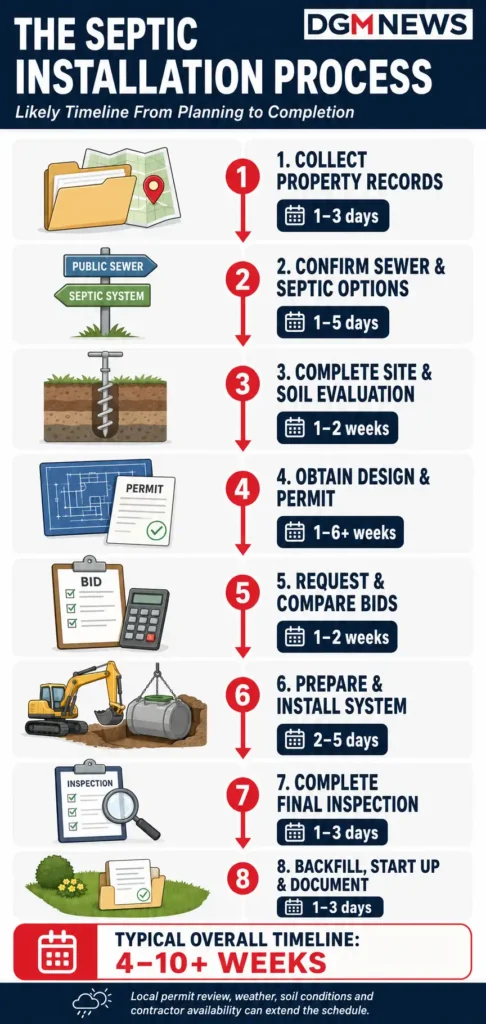
The physical construction may take only a few days. However, approval, design, contractor availability, weather, and inspections often control the overall schedule.
1. Collect Property Records
Request the existing permit, approved plan, as-built drawing, repair history, and pumping records from the local authority or previous owner.
These records can prevent unnecessary searching and show whether a reserve field was designated.
2. Confirm Sewer and Septic Options
Ask whether a public sewer connection is available or mandatory. If a sewer extension is planned nearby, compare connection rules and timing before investing in a new onsite system.
3. Complete the Site and Soil Evaluation
The evaluator identifies:
- Usable soil
- Limiting soil conditions
- Required setbacks
- Property slope
- Groundwater indicators
- Potential tank locations
- Potential drainfield locations
Seasonal restrictions or wet weather can delay this stage.
4. Obtain the Design and Permit
A straightforward system may use a standard plan. A difficult site may require an engineer or licensed septic designer.
Permit review can take days or several weeks, depending on the jurisdiction and whether revisions are required.
5. Request Itemized Bids on the Same Plan
Give each installer the approved design and the same restoration expectations. This creates comparable quotes and reduces assumptions.
6. Prepare and Install
The contractor clears approved areas, excavates the site, places the tank, installs piping and distribution components, and builds the drainfield.
The crew also installs pumps or controls when required. Utility locating must happen before digging.
7. Complete Inspection Before Backfilling
The permitting authority or designer may need to inspect:
- Open trenches
- System elevations
- Tank connections
- Pipe materials
- Drainfield materials
- Pumps and alarms
- Setback distances
Do not allow work that must be inspected to be covered prematurely.
8. Backfill, Start Up, and Document the System
After approval, the contractor backfills and grades the site, tests alarms and pumps, and explains how to operate the system.
Keep copies of:
- Final approval
- Inspection reports
- Installation photographs
- Component manuals
- Warranty documents
- Maintenance agreement
- Updated as-built drawing
How to Compare Septic Installer Quotes
Three totals are not enough. Each written proposal should answer the following questions:
- Is the contractor bidding from the current approved design?
- What tank capacity, material, manufacturer, and model are included?
- Are delivery, crane service, bedding, risers, lids, and an effluent filter included?
- What drainfield type, dimensions, materials, and distribution method are included?
- Are the house connection, pipe lengths, distribution box, pump chamber, alarm, and electrical work included?
- Who obtains and pays for the permits, design, inspection, and utility locating?
- Is pumping and lawful abandonment of the old system included?
- How will rock, groundwater, unsuitable soil, or extra excavation be priced?
- Does “restoration” mean rough backfill or finished topsoil, seed, sod, and irrigation repair?
- What workmanship and equipment warranties apply?
- Is startup or an ongoing maintenance contract required?
- What payment schedule applies?
- How are change orders approved?
Verify the installer’s required state or local license and insurance. Ask the permitting office whether it maintains a list of qualified professionals.
The EPA also directs homeowners to the National Onsite Wastewater Recycling Association’s professional locator. However, licensing requirements vary by state.
Hidden Costs to Address Before Signing
Rock and Unexpected Groundwater
The contractor may not know exactly what lies below the surface until excavation begins.
Ask for:
- Hourly equipment rates
- Rock-removal rates
- Material markups
- Dewatering charges
- Hauling costs
- A not-to-exceed process for unexpected work
Tree and Fence Removal
Removing a mature tree, dismantling a fence, or creating a temporary equipment route can involve separate contractors. Confirm who removes and restores these items.
Electrical Work
Aerobic units and pumped systems need power, controls, and alarms. A septic installer may exclude:
- The electrician
- Electrical permits
- Panel upgrades
- Wiring trenches
- Alarm installation
- Generator connections
Temporary Loss of Plumbing
The household may be unable to use normal plumbing during part of a replacement.
Ask how long service will be interrupted and whether temporary pumping or alternative accommodation will be necessary.
Water-Well Protection and Testing
The system must meet local setbacks from wells and water features. A suspected failure may also justify professional water testing.
Do not place a new component based on convenience alone.
Financing and Required Service Contracts
Alternative systems can bring recurring inspection, electricity, testing, and maintenance costs. Include these costs when comparing a lower installation bid with a more durable or simpler approved design.
Homeowners facing a failed system can review the EPA’s state-by-state funding page. It lists selected loan, grant, and assistance programs.
Eligibility and funding can change. Confirm the current requirements directly with the program.
Safe Ways to Reduce Septic Installation Cost
Retrieve Records Before Paying for New Investigations
An existing as-built plan, soil report, or permit may reduce duplicated work. It can also show the exact location of the tank and drainfield.
Get Three Bids After Design Approval
Bidding too early produces vague allowances instead of comparable prices.
First, establish what the permitting authority will approve. Then ask experienced installers to price the same scope.
Protect the Approved Septic Area
Construction traffic can compact soil and damage the future drainfield.
Mark the primary and reserve areas. Keep vehicles, stored materials, and heavy equipment away unless the installer’s approved plan requires access.
Ask About Lawful Owner-Completed Work
Some contractors may allow the homeowner to handle limited clearing or final seeding. Get written approval before completing any work.
Poor grading, compacted soil, or unapproved excavation can damage the system and make responsibility unclear.
Do Not Buy Components Before Approval
A bargain tank becomes expensive if it:
- Has the wrong capacity
- Lacks local approval
- Cannot handle site conditions
- Is unsuitable for the groundwater level
- Does not match the approved design
Let the design and permit establish the required specifications.
Avoid False Savings on Permits or Installation
Improper installation can contaminate groundwater, create sewage exposure, complicate a home sale, and require the work to be uncovered or replaced.
Septic installation is not a sensible general DIY project. Use qualified professionals and obtain all required inspections.
Budget for Ownership After Installation
Installation is not the final expense. A conventional system generally needs periodic inspection and pumping.
The EPA advises homeowners to have a typical household system inspected at least every three years and the tank pumped every three to five years.
Systems with electrical switches, pumps, or mechanical parts should generally be inspected more frequently. Actual pumping frequency depends on:
- Household size
- Wastewater volume
- Tank capacity
- Volume of solids
- Local requirements
- Garbage disposal use
Current consumer data from HomeGuide commonly place pumping around $300 to $700 per visit and a basic inspection around $150 to $450.
Access, tank size, location, and inspection scope affect the final charge. An aerobic or pumped system may also require electricity, replacement parts, and a service agreement.
Protect the investment by:
- Repairing plumbing leaks
- Spreading laundry use across the week
- Keeping grease out of drains
- Avoiding non-flushable wipes
- Keeping vehicles off the drainfield
- Avoiding structures over the system
- Planting trees away from the drainfield
- Directing stormwater away from the field
- Keeping tank risers accessible
- Saving every pumping and service record
Homeowner Action Plan Before Accepting a Quote
- Contact the local health or environmental department for rules, records, approved professionals, and permit steps.
- Confirm whether the job is a tank replacement, drainfield replacement, or complete new system.
- Complete the required soil and site evaluation before choosing a system or buying a tank.
- Obtain an approved design that states capacity, design flow, system type, location, and reserve area.
- Request at least three itemized bids based on the same approved design.
- Compare exclusions, change-order rates, restoration, warranties, and ongoing service—not only the total.
- Keep a 10% to 15% planning reserve until excavation and final approval are complete.
- Save the permit, inspection approval, as-built drawing, photographs, manuals, warranties, and maintenance schedule.
The Bottom Line
For early planning, expect a complete conventional septic tank installation cost of approximately $3,500 to $12,500, with many national estimates centered near $8,000.
A site requiring pumps, additional treatment, a mound, difficult excavation, or engineering can cost $15,000 to $50,000 or more. The tank alone is usually a small part of the full price.
The most accurate budget comes from four items:
- A local soil evaluation
- An approved system design
- An itemized contractor bid
- Clearly defined exclusions
Start with the permitting authority, not a tank catalog. This approach protects the property, makes contractor quotes easier to compare, and reduces the chance of an expensive redesign after work begins.