


A child support lawyer is a family-law attorney who helps a parent establish, calculate, change, or enforce a child support order. A lawyer can also respond to an incorrect claim or enforcement action. Private counsel may not be necessary in a simple, uncontested case. Legal help becomes valuable when income is disputed, payments are overdue, another state is involved, or a hearing is approaching.
This guide explains the U.S. process in general. Child support laws, formulas, filing deadlines, and court procedures vary by state. It is legal information, not advice for a particular case.
Do You Need a Child Support Lawyer?
Hiring a lawyer is usually worth considering when a mistake could materially affect your finances or your child’s support. Speak with a local family-law attorney promptly if:
- You have received a petition, summons, contempt motion, or hearing notice.
- The other parent appears to hide income, work for cash, or control a business.
- Your income has dropped and you cannot pay the ordered amount.
- The amount proposed by the other parent or agency appears inaccurate.
- Parentage is disputed.
- Substantial arrears, interest, or payment credits are in dispute.
- Your child has unusual medical, educational, or care expenses.
- The case involves another jurisdiction, custody, or domestic violence.
For an uncomplicated case, your state or tribal child support agency may be able to establish, change, or enforce an order. USAGov explains the available agency services, including cases in which the other parent lives elsewhere.
The key difference is representation. An agency handles the public program; its lawyer may not be your personal lawyer. A private child support lawyer represents your interests, provides confidential advice, and develops your case strategy.
| Your situation | A practical starting point |
|---|---|
| Both parents disclose regular wages and agree on the facts | Use the state calculator, court self-help service, or child support agency; consider a legal review before signing |
| Income, parenting time, expenses, or arrears are disputed | Consult a child support lawyer |
| You were served with court papers or face contempt | Get legal advice immediately and do not miss the response deadline |
| You cannot afford private representation | Contact the child support agency, court self-help center, or a legal-aid provider |
What a Child Support Lawyer Can Do
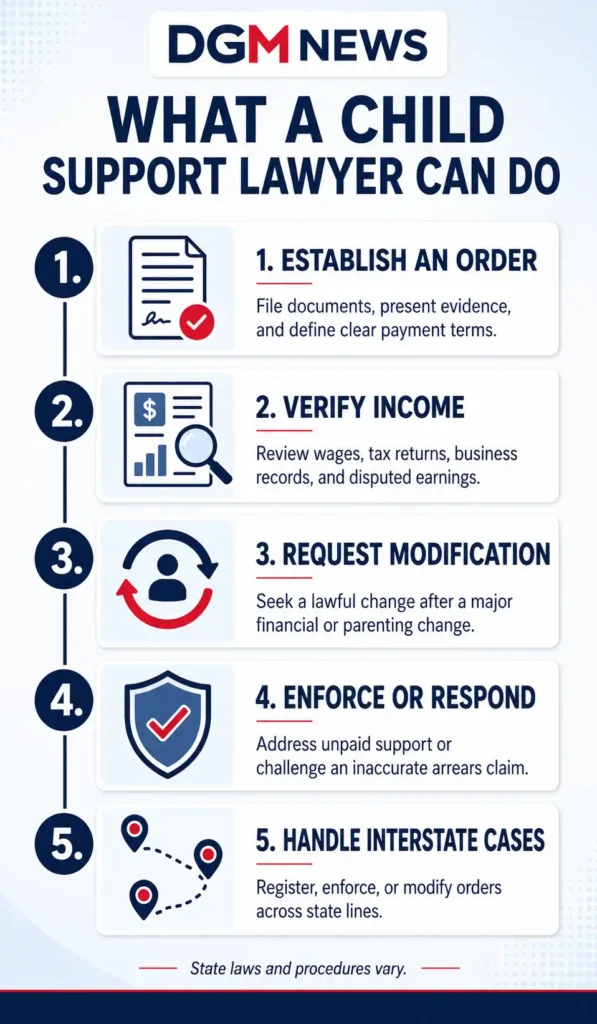
Establish a Legally Enforceable Order
An informal promise does not provide the protection of a court or administrative order. An attorney can identify the correct court, prepare the petition, arrange service, present financial evidence, and draft clear payment and expense terms.
If legal parentage is unresolved, the case may involve an acknowledgment, genetic testing, or a hearing. A lawyer can explain the consequences before you sign a document or agree to an order.
Present an Accurate Income Picture
Child support cases depend on reliable financial evidence. A lawyer can organize wage statements, tax returns, business records, benefits, and child-related costs. When allowed, the lawyer may use discovery, subpoenas, or testimony to examine disputed income.
This assistance is particularly useful when a parent:
- Owns a company.
- Receives commissions, bonuses, or other variable pay.
- Works partly for cash.
- Claims unusually high business deductions.
- Has several sources of income.
- Appears voluntarily unemployed or underemployed.
The objective should be an accurate calculation supported by admissible evidence, rather than simply obtaining the highest or lowest possible amount.
Request a Child Support Modification
A material change in income, parenting time, childcare, insurance, or the child’s needs may support a modification. However, the change does not automatically alter the existing order. The requesting parent must follow the local process and meet the state’s legal standard.
Act quickly after a substantial financial change. Under 42 U.S.C. § 666(a)(9), a modification generally cannot change installments that became due before the other party received notice of the modification request.
Exact rules differ, but the existing amount may continue to accumulate while the case is pending. Losing a job, becoming ill, or experiencing a reduction in income does not give a parent permission to stop paying without requesting a formal change.
Enforce Unpaid Child Support
When a parent fails to pay, a lawyer can verify the official payment ledger, calculate arrears, and seek a remedy available under state law.
Possible enforcement methods may include:
- Income withholding.
- Interception of eligible tax refunds.
- Property or financial account liens.
- License suspension.
- A judgment for unpaid support.
- A contempt proceeding.
- An approved repayment arrangement.
Not every remedy applies to every case, and an attorney cannot guarantee collection.
If you are accused of nonpayment, a lawyer can examine the account for clerical errors, uncredited payments, an incorrect effective date, or amounts already satisfied. Counsel can also present evidence about your ability to pay and explain lawful options for addressing arrears.
Never conceal assets, alter payment records, or disregard an order merely because you believe it is unfair.
Handle Interstate or International Cases
Moving to another state does not normally end a child support obligation. Interstate cases can raise questions about which state may establish, modify, or enforce the order.
Federal guidance explains how the interstate framework identifies one controlling current-support order, but determining jurisdiction can still be complicated.
A lawyer can establish whether:
- An order must be registered in another state.
- The original state retains authority to modify it.
- A different state can enforce the existing order.
- Another state’s child support agency should become involved.
- The case requires international enforcement procedures.
International cases may require a lawyer with specific experience in cross-border support disputes.
How Is Child Support Calculated?
There is no nationwide child support amount. Federal regulations require every state to maintain guidelines. These guidelines create a presumptive amount, although an authorized decision-maker may allow a qualifying deviation.
Depending on the state, the calculation may consider:
- Each parent’s income or the paying parent’s income.
- The number of children covered by the order.
- The parenting schedule or number of overnight visits.
- Childcare required for work or education.
- Health insurance premiums.
- Uninsured medical expenses.
- Existing legal support obligations.
- Extraordinary educational, medical, or travel costs.
- Other deductions or adjustments allowed by state law.
Income may include more than regular wages. Depending on the applicable rules, bonuses, commissions, self-employment earnings, investment income, benefits, overtime, or other recurring payments may affect the calculation.
Shared parenting does not necessarily reduce child support to zero. Similarly, a new spouse’s income is not automatically treated as the parent’s income, although state rules differ.
Use your state’s official child support calculator for an initial estimate. A calculator cannot resolve disputed income, determine credibility, approve a deviation, or decide which evidence can be used.
What Happens After You Hire a Lawyer?
1. Case Assessment
The lawyer reviews the existing order, court docket, payment history, deadlines, finances, and desired outcome. Expect a realistic assessment of the evidence, procedure, possible results, and likely costs—not a promised result.
2. Financial Disclosure and Evidence
Both parents may have to exchange financial forms and supporting records. Provide complete and accurate information. Hidden income, omitted accounts, or false statements can damage your credibility and may lead to penalties.
3. Filing and Service
The lawyer prepares the correct request or response and follows the jurisdiction’s filing and service requirements. Proper service provides the opposing party with legally sufficient notice.
4. Negotiation or Mediation
Many cases end with a negotiated order. Before consenting, understand the calculation, future obligations, arrears, health coverage, additional expenses, and enforcement terms. A judge or agency may still need to approve the agreement.
5. Hearing and Final Order
If no agreement is possible, the attorney presents evidence, questions witnesses, and challenges unsupported claims. After the decision, read the signed order carefully. Note when, where, and how payments must be made.
Documents to Take to the First Consultation
Bring the documents you already have. Do not miss a filing deadline while trying to assemble a perfect file.
Useful records include:
- Every existing support, custody, divorce, or parentage order.
- The petition, summons, motion, and hearing notice.
- Recent pay stubs and tax returns.
- Business, commission, benefit, or unemployment records.
- The official payment ledger.
- Proof of direct payments.
- Childcare and health insurance bills.
- Medical, educational, and travel expenses.
- A calendar showing parenting time.
- Relevant written communication with the other parent or agency.
Create a brief timeline of important events. Separate facts you can prove from suspicions or assumptions. Good organization can save consultation time and help the lawyer identify missing evidence.
How Much Does a Child Support Lawyer Cost?
Fees depend on the lawyer’s location and experience, the complexity of the case, its urgency, and whether the parties reach an agreement.
A law firm may:
- Charge hourly fees against an advance retainer.
- Offer a flat fee for a clearly defined service.
- Provide limited-scope representation.
- Charge separately for court appearances.
- Require payment for filing, service, expert, or transcript costs.
Ask for a written fee agreement. Confirm the billing increment, who will work on the case, what the retainer covers, how often you will receive statements, and what happens to unused funds.
In some jurisdictions, a court may order one party to contribute toward the other party’s legal fees. However, never assume that your attorney’s fees will be reimbursed.
How to Choose the Right Child Support Lawyer
Choose an attorney licensed in the state handling the case and familiar with the local family court. During the consultation, ask:
- How much of your practice involves child support cases?
- Have you handled self-employment, disputed income, arrears, or interstate cases like mine?
- What is my most urgent deadline?
- What action do you recommend taking first?
- What information could change your initial assessment?
- Can any part of the case use limited-scope representation?
- Who will communicate with me and appear at hearings?
- What is the realistic fee range through settlement and a contested hearing?
Be cautious of anyone who guarantees a particular result, encourages you to hide information, or treats aggressive conflict as the only strategy. A capable lawyer should be direct, evidence-focused, and prepared to explain both settlement and litigation options.
Mistakes That Can Harm a Child Support Case
- Ignoring legal papers: A default order may be entered without your financial evidence.
- Stopping payments yourself: The existing order remains effective until it is legally changed.
- Paying without keeping records: Use the official payment channel unless the order states otherwise.
- Treating visitation and support as a trade: They are generally separate legal obligations.
- Posting financial claims online: Public statements may conflict with your sworn disclosures.
- Signing under pressure: Understand the income figures, arrears, medical support, and duration first.
- Waiting after a financial change: Delay may limit how far back a modification can operate.
Frequently Asked Questions
A lawyer cannot promise a reduction. The attorney can determine whether you qualify for modification, calculate the guideline amount, correct inaccurate figures, and present supporting evidence.
Until a new order is entered, continue following the existing one unless a local attorney advises you differently.
A lawyer can request enforcement and challenge an inaccurate payment history. Recovery depends on the paying parent’s income, assets, circumstances, the age of the debt, and state law. A child support agency may also provide collection services.
Parents may propose an agreement, but a private arrangement may require court or agency approval before it becomes enforceable.
Put every approved change into a formal order. Do not rely only on a verbal promise, email, or text message.
Yes. Child support is not limited to divorce cases. Unmarried parents may need to establish legal parentage before support can be ordered.
Because signing a parentage document can have lasting consequences, obtain local legal advice when identity or parentage is uncertain.
Contact your state or tribal child support agency, local court self-help center, or legal-aid organization. USAGov lists free and low-cost legal-help resources. You can also ask private attorneys about a focused consultation or limited-scope representation.
Final Takeaway
A child support lawyer is most useful when financial facts are disputed, the consequences are substantial, or the legal procedure is difficult to manage alone.
Start by preserving your records and checking every deadline. Then compare the services available through your child support agency with the personalized advice and advocacy offered by a private lawyer.
If you have been served, face enforcement, or need a lower order after a major financial change, act promptly. The current order does not pause while you decide what to do.